
Police Scotland has confirmed its revised approach to sex and gender data, where data collected about suspects and victims of all crimes and offences will ask about ‘biological sex registered at birth’.
This replaces Police Scotland’s previous self-identification approach with a blanket policy applied across all data collection activities. In practice, it prioritises ‘biological sex registered at birth’ in ways that exclude or misrecognise people’s lived experiences.
Police Scotland justifies this change by using the language of ‘data accuracy’. However, as I have argued elsewhere, ‘data accuracy’ is a term that ‘enjoys the privilege of being deployed without evoking its underlying politics’ (p. 13).
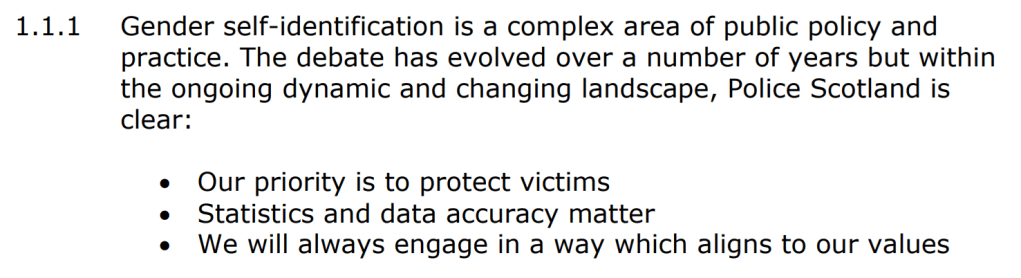
In fact, this new approach may produce data that is less reliable than before the undertaking of a Sex and Gender Review.
The problem is simple: a gap now exists between what Police Scotland says it is recording about sex/gender and what people actually report about themselves.
For example, if I go to my local police station to report my neighbour for shouting homophobic abuse, and an officer asks me to complete a form asking about my ‘biological sex’ how is he going to verify the ‘accuracy’ of my answer? Will officers be expected to question people whose appearance does not match their assumptions? What if I’ve ticked the ‘male’ box but don’t look manly enough? Any effort to verify the data someone shares about their sex and gender will create situations where frontline staff are expected to (excuse the pun) police the sex and gender of people they encounter in their work. This is an unwelcome (and unworkable) development for staff and many people sharing information about themselves with the police.
I engaged with Police Scotland during their Review and raised these concerns several times. I repeatedly stressed the importance of collecting data in ways that best inform the activities of Police Scotland, and how this approach may involve asking different questions about sex and gender in different policing contexts. Instead, the Review has opted for a catch-all approach to sex and gender data that ultimately risks creating more problems than it solves.
The promise of clarity achieves inverse outcomes
As with many sex and gender reviews, the entire exercise was a solution in search of a problem – an effort to assuage the demands of trans-exclusionary campaign groups, certain politicians and the media. Police Scotland had not identified any major issues with its previous approach to sex and gender data.
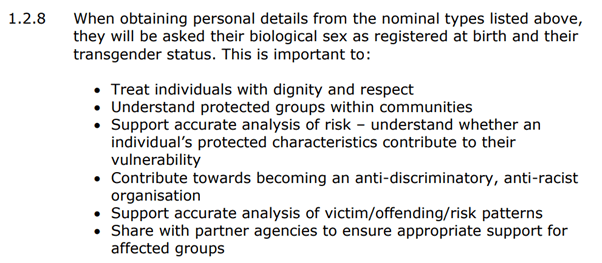
The reasons cited for asking everyone about ‘biological sex registered at birth’ also sit uneasily with Police Scotland’s wider commitments. For example, it is unclear how asking a victim of crime about their ‘biological sex registered at birth’ contributes to the organisation’s anti-racist aspirations (see fig. 2). If anything, a biology-first approach to sex data is more aligned with ‘scientific racism’ of previous centuries: if Police Scotland is now asking questions about ‘biological sex’, why not also start asking about ‘biological race’?
For trans people in Scotland, this development is likely to feel especially painful. Police Scotland says the change is intended to ‘treat individuals with dignity and respect’. However, asking a trans man or woman who is reporting a crime about their ‘biological sex registered at birth’ feels like the opposite of dignity and respect.
We may now see Police Scotland publish data that claims to exclusively report information about people’s ‘biological sex registered at birth’ but this data will continue to contain a mixture of information about sex and gender. In other words, datasets will falsely describe their contents as one thing but report something different. As is often the case, the promise of clarity achieves inverse outcomes.
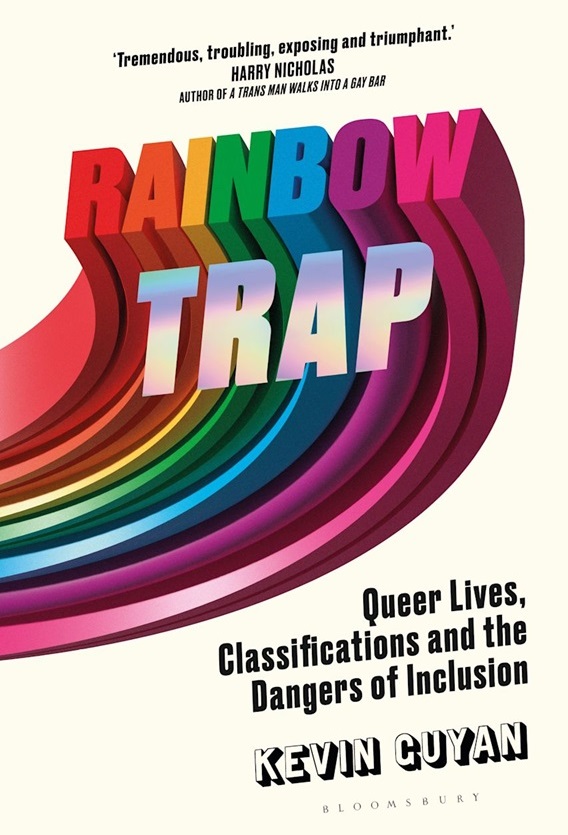
Kevin Guyan is the author of the article Trans-exclusionary data activism in the UK (2026) and the book Rainbow Trap: Classifications, Queer Lives and the Dangers of Inclusion (Bloomsbury Academic, 2025).
 Kevin Guyan
Leave a comment