
The UK Supreme Court ruling suggests that all public authorities should collect data about a person’s ‘biological sex’ – how would this work in practice and how can we ensure we don’t abandon inclusive approaches to data?
I’ve spent the past month reflecting on what the ruling means for how organisations collect, analyse and use diversity data. My conclusion is that this moment reflects the endgame for current approaches to diversity data – and perhaps that is no bad thing.
Capturing quantitative data about the nine protected characteristics listed in the Equality Act, crunching the numbers and then using the data to report the demographic insights into your workforce or pay gaps between different groups is a relatively recent phenomenon. It is also particular to the UK and its recent history of equalities work.
This history took an unexpected turn on 16 April 2025 when the Supreme Court ruled that ‘sex’ in the Equality Act should be interpreted as meaning ‘biological sex’ or sex at birth only.[1] This narrow definition of ‘sex’ upended a previous working-understanding where ‘sex’ included multiple meanings related to biology, legal status and self-identification.
For those working with data, this change is important because many public bodies must collect, analyse and report information about the identity characteristics of individuals (such as employees and service users) that align with the requirements of the Equality Act. If ‘sex’ is understood to mean ‘biological sex’ then – one can assume – diversity monitoring questions about ‘sex’ and ‘sexual orientation’ should also ask about ‘biological sex’.
I call this change a biology-first approach to diversity data.
Regardless of what the ruling will actually mean in practice, the optics of the Supreme Court decision risks destroying the delicate data systems that DEI practitioners have spent decades trying to build. Efforts to engage minoritised communities, foster trust and honesty, and design systems that are accessible and inclusive are abandoned if a biology-first approach is embraced by public authorities in response to the Supreme Court ruling.
Today’s diversity data system will eat itself – it will become creaky and cumbersome, destroyed by the design of the questions it asks people to answer. It will die and should be replaced by something better.
Why stop with a biology-first approach to sex data?
The elephant in the room – or ink spill on the diversity monitoring form – is that a biology-first approach to diversity data does not just relate to the capture of information about ‘sex’. Less discussed but the ruling also made clear that a biology-first definition also applies to how the protected characteristic of ‘sexual orientation’ is understood in the Equality Act.
As legal expert Robert Mullins observes, the ruling places a ‘biological straitjacket on sexual orientation’ that foregrounds a ‘“biological sex” interpretation of same-sex orientation’.
In this reading, you only count as a gay man if you are a ‘biological’ man who is attracted to other ‘biological’ men – a crude position that jars with how many LGBQ+ people experience sexuality, desire, attraction and love.
And why stop with sexual orientation? Let’s keep on this slippery slope and reinterpret other protected characteristics in the Equality Act through a biology-first lens. We are worryingly just a few steps away from expecting diversity data practitioners to be checking the validity of a person’s skin colour or measuring their skull size before determining how they should be counted in an organisation’s race pay gap reporting.
Diversity data is a messy business (but so is life!)
A closer reading of what the Supreme Court ruling said about data highlights a failure to acknowledge that the collection, analysis and use of data about identity categories is a messy business.
In their discussion of data collection for the Public Sector Equality Duty (part of the Equality Act), the court takes issue with how the category of ‘female’ is inclusive of ‘biological women, some biological males with a GRC (trans women who are legally female) and excluding some biological females with a GRC (trans men who are legally male)’. The ruling goes on to bemoan that ‘any data collection exercise will be distorted by the heterogenous nature of such a group’ and ‘do not understand how the interests of this heterogenous group can begin to be considered and addressed’. [2]
This critique is similar to the thrust of the argument made in Alice Sullivan’s partisan Review of Data, Statistics and Research on Sex and Gender (2025), which claims that the UK has underwent ‘a widespread loss of data on sex’ and that ‘the meaning of sex is no longer stable in administrative or major survey data’ because a diversity of experiences exists within the categories of ‘male’ and ‘female’.
But – err – isn’t the heterogenous nature of these categories reflective of how they are experienced in the social world? The category of woman includes a vast array of races, ethnicities, social classes, ages, abilities and sexualities – by throwing trans women out of the category, does it become any more of a homogenous category? Maybe if they restrict the category to white women only it would become even more homogenous? Or, while they’re at it, why not throw out disabled women too?
What would a biology-first approach to diversity data look like?
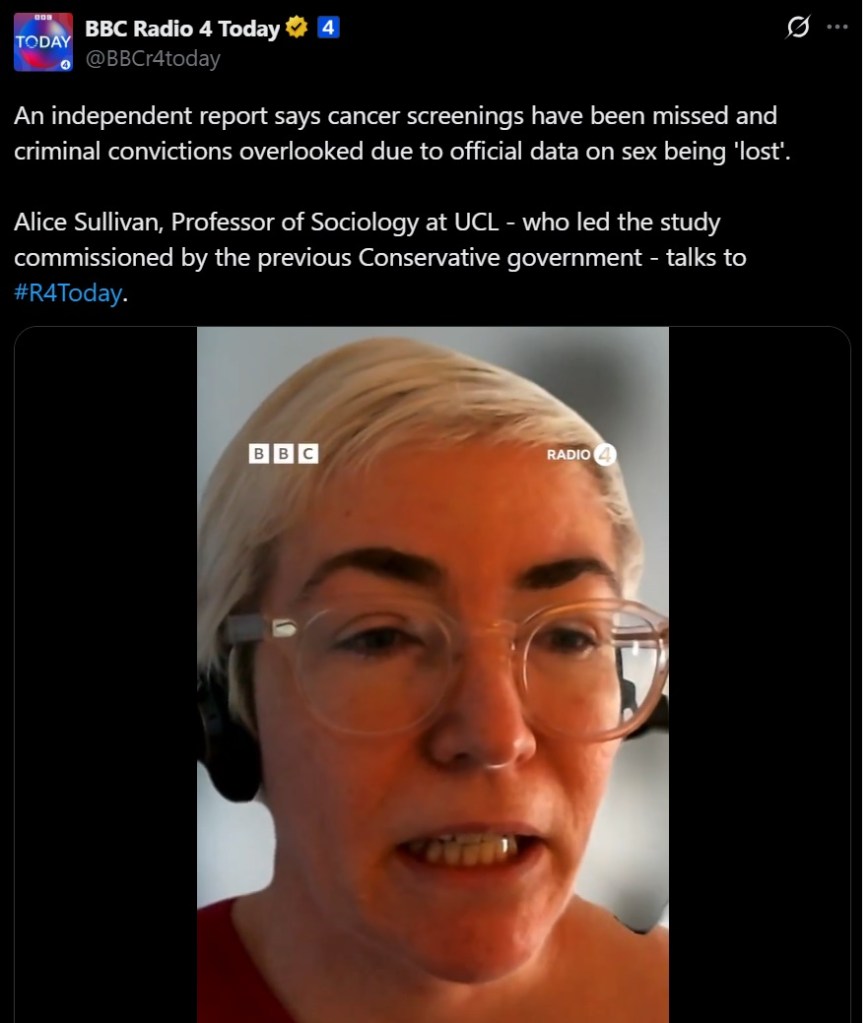
High-profile individuals calling for a biology-first approach to diversity data (including Sullivan and Maya Forstater, CEO of the anti-trans campaign group Sex Matters) feature prominently in media coverage of this topic but it is less common to hear them articulate how exactly a biology-first approach to data would work in practice.[3]
Media soundbites like everyone needs ‘accurate data for good policymaking’ and ‘we need useful categories’ sound nice in a cosy interview with Justin Webb on BBC Radio 4’s Today programme but – when implemented in the real world – how would organisations justify asking questions about ‘biological sex’ and how would people respond?
What is missing from texts like the Sullivan Review is a recognition that the collection of data about human subjects involve working with human subjects.
In my new book Rainbow Trap: Queer Lives, Classifications and the Dangers of Inclusion, I argue that ‘gender critical’ approaches to gender, sex and sexuality data promote ‘an idealised vision of classifications with streamlined categories […] and docile subjects who merrily go into the box they are instructed to join, even when they know it is a bad fit. It is a classification fantasy’. To put it plainly – individuals talk back to the data systems collecting information about them.
Since the Supreme Court ruling, we have witnessed (at long last) more critical attention in the media to the harms and impracticalities of segregating public toilets according to ‘biological sex’, as it begs the fairly obvious question: who is tasked with policing that people use the ‘correct’ toilet and how are they going to do this?
The Equality and Human Rights Commission – which actively campaigns against equality and human rights for trans people – has suggested that for staff in public venues, ‘if there is genuine concern about the accuracy of the response to a question about birth sex, then a birth certificate could be requested’. If adopted, this new reality seems even worse than the situation anti-trans campaigners claimed had existed before. Surely, a cis woman peeing alongside a trans woman in a separate cubicle is less harrowing than being asked by Dave in reception to prove you’re a woman and being required to carry your birth certificate everywhere you go? If this proposal didn’t involve real people (bursting for a pee), it would be farcical.
It is important to emphasise that the Sullivan Review (which I have previously written about) does not simply propose adopting a biology-first approach for questions related to health and medical matters, the Review proposes biology-first questions as the default for all research and statistical exercises.
Designing a survey of people’s experiences using public transport – what’s your biological sex?
Asking about workforce diversity in the film and TV industry – what’s your biological sex?
Want to find out what time of the day people walk their dog – what’s your biological sex?
Again – and it’s a point worth stressing – the Review provides recommendations for collecting data about human subjects that is entirely devoid of how human subjects will respond to being asked about their biology in contexts where this information is irrelevant. Having worked as gender and sexuality researcher for over a decade, I can guarantee that asking someone biology-first questions about their ‘sex’ and ‘sexual orientation’ – when it’s not relevant to the topic being discussed – will create situations where researchers are impolitely told to ‘fuck off’.
As figures like Sullivan appear coy about plainly stating how their vision for a biology-first approach to data would work in practice, I’ve suggested diversity monitoring questions that align with recommendations in the Sullivan Review and the Supreme Court ruling:
Q. What is your sex?
Following the 16 April 2025 Supreme Court ruling and in accordance with the 2010 Equality Act, this question is asking about your biological sex or sex at birth.
- Female
- Male
What particularly strikes me about this question – ignoring the narrowness of the options made available – is that it’s all about looking backwards.
Imagine this situation: a trans woman visits her local library – let’s call her Anna – and is asked to complete a survey about her experience of using the council service. Anna is 75 and transitioned in the 1970s. She has lived as a woman for over 50 years, has a Gender Recognition Certificate and is recorded as ‘female’ on her birth certificate, driving license and passport. Anna has had every gender affirming care on offer (including surgery, hormone therapy etc.) with the support of her two older children, who refer to her as ‘mum’. Basically, she ticks all of the boxes that anti-trans campaigners put forward for who counts as woman. But because at birth – in 1950! – she was recorded as ‘male’ she should answer this survey about her local library by ticking the ‘male’ box?
Similar issues are apparent with a biology-first approach to sexual orientation:
Q. What is your sexual orientation?
Following the 16 April 2025 Supreme Court ruling and in accordance with the 2010 Equality Act, this question is asking about the biological sex or sex at birth of yourself and the person you have a sexual orientation toward.
- Heterosexual/straight
- Bisexual
- Gay/lesbian
Personally, as a gay man who is happy to identify as ‘gay’ in most diversity monitoring exercises, I would never again tick the box ‘gay’ if this definition is restricted to a biology-first account that excludes trans men from this category.
It is a non-sensical approach to data that does not align with people’s experiences of the phenomena being asked about. If adopted by public authorities, it would lead to the implosion of the current diversity data system.
Data accuracy
There is a reason that a self-identification approach to diversity data is prevalent in the UK. It is not simply because most researchers believe that individuals are best placed to describe their lives and experiences – rather, to adopt an external-identification approach (the opposite of a self-id approach) would break the data system.
Just because you instruct a trans woman that she should identify as ‘male’ in a workplace diversity monitoring form does not mean she will. So you end up with a dataset where the quality is diminished because what the question claims to measure (the ‘biological sex’ of workers) is not the same as what it actually measures.
However, I fear the risk of measurement error is all part of the plan. ‘Gender critical’ researcher Lucy Hunter Blackburn (of the campaign group Murray Blackburn Mackenzie, commissioned to conduct research for the Sullivan Review) argued on social media on 27 April 2025 that the government might need to make it a crime to ‘misrepresent your sex’.

In this account of the world, when the design of data and administrative systems are intentionally changed so you are not recognised – the problem is not with the data or administrative system, the problem is with you. Your actions – as a trans person – are understood as fraudulent.
Trans lives and experience are recast as ‘inaccurate’, as if the data collector knows the ‘correct’ answer and a trans respondent is being difficult or breaking the rules by choosing to answer the question in another way.
In Rainbow Trap, I describe how the ‘vision of the world presented by organizations such as Sex Matters, LGB Alliance and “gender critical” academics is a fiction that assumes everyone’s lives can (and should) map directly to clear categories with discrete boundaries. For queer people who do not fit the options presented, compromise is impossible. These communities face a violent form of inclusion, where they must pick between being coerced into a box – not of their choosing – or jettisoned outside of the classification system, where they are not just miscategorized but are made incomprehensible’.
A twin track solution
Working in a Business School, I have received many queries in recent weeks from organisations asking how to collect diversity data in a way that is compliant with reporting requirements of the Equality Act (most notably public authorities and the PSED) but does not abandon work so far on inclusive approaches to data.
The Equality Act is a floor not a ceiling for what organisations can do to improve equality, diversity and inclusion within their workplace. There is nothing stopping organisations going above and beyond the requirements of the Equality Act, as long as they are compliant with its basic requirements.
This ‘floor not ceiling’ mindset should inform our approach to data. If the Supreme Court ruling requires organisations to include a biology-first question on sex and sexual orientations, we can include these questions to ensure our approach is compliant.
But let’s not stop there – let’s also more ask inclusive questions about gender and sexual orientation that meets respondents where they are at.
I am therefore proposing a twin-track approach to diversity data where organisations would collect two pieces of information about a person’s sex/gender and sexual orientation:
- An inclusive gender and sexual orientation question.
- A biology-first sex and sexual orientation question.
- In addition, organisations would also ask a trans status/history question to count how many people identify as trans, cis or in another way.[4]
I want to make clear that I am proposing a question on ‘gender’ not ‘gender identity’, which is a narrower term that often exclusively relates to the counting of trans communities (and comes with unwieldy descriptor ‘identity’ stuck on at the end… we don’t ask about ‘race identity’ or ‘sex identity’).
My proposed Track A questions would be something like:
Q. How would you describe your gender? (Select all that apply)
This question recognises that, for many people, their gender and/or sex encapsulates more dimensions than biology – it is intentionally inclusive.
- Woman
- Man
- Non-binary
- In another way (specify, if you wish):
- Prefer not to say
Q. How would you describe your sexual orientation? (Select all that apply)
This question recognises that, for many people, their sexual orientation encapsulates more dimensions than biology – it is intentionally inclusive.
- Heterosexual/straight
- Bisexual
- Gay/lesbian
- Queer
- Asexual
- In another way (specify, if you wish):
- Prefer not to say
Track A questions continue and build upon current approaches to diversity data, reflecting feedback from community engagement, employees, data users etc. Track B questions (noted earlier in my article) are new questions included to comply with the Supreme Court ruling. You can download the full suite of questions here.
Asking more than one question about an identity category is not a problem as diversity monitoring forms already ask multiple questions about a person’s socioeconomic status (e.g. your parent’s profession at aged 14, what type of school you attended and whether you received free school meals).
This approach differs from what is proposed in the Sullivan Review, which recommends that data collection exercises ask a (biology-first) ‘sex’ question and ‘gender identity’ question. With my approach, the ‘gender’ question is not devalued as some sort of frilly add-on, it is understood as offering the most robust information about the group under investigation.
I believe that a vast number of people – the majority of whom are cisgender and straight – will choose to refuse to answer biology-first questions about sex and sexual orientation.
Unsurprisingly to anyone involved in the design of data practices, questions that are inclusive and accessible will offer the best insights into the topics being investigated. Over time, the quality and meaningfulness of biology-first questions will diminish as respondents (understandably) choose not to respond or share incoherent answers to questions asking about ‘biological sex’ when registering for a library card or responding to a survey about public transport.
We need to lead the design of data systems and practices, not be led by them. Figures like Sullivan can instruct organisations to ask questions about a person’s ‘biological sex’ in all contexts – what they cannot control is how individuals being asked these questions respond.
That is why – over decades – many people have made huge efforts to design and manage data systems that are inclusive, open and flexible to the complexity of the world around us. What I propose here clings on to the good that is around us, complies with the letter of the law and – most importantly – pushes back against efforts to erase trans, non-binary and queer people from existing in data.
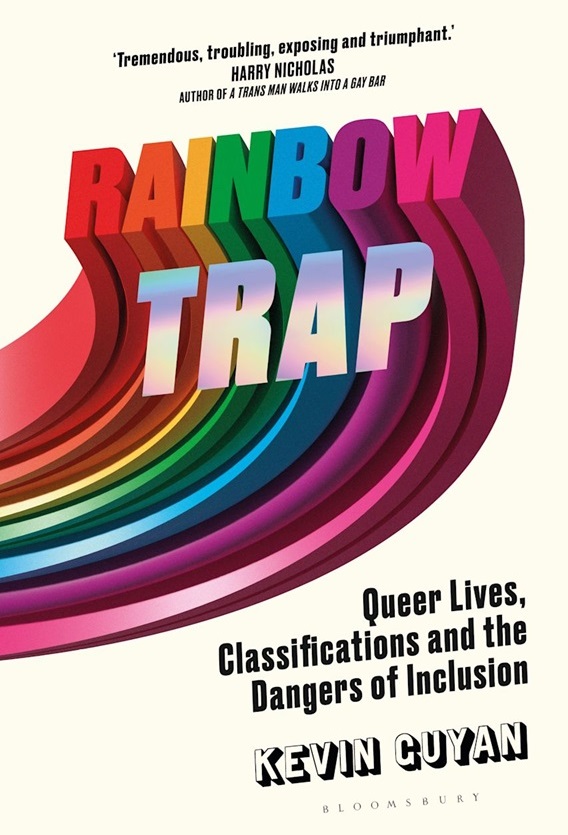
Kevin Guyan is the author of Rainbow Trap: Classifications, Queer Lives and the Dangers of Inclusion (Bloomsbury Academic, 2025), available to preorder now.
[1] Confusingly, the ruling also states that ‘biological sex’ is understood as meaning a person’s sex as recorded at birth – a type of certification and imperfect proxy for the biological characteristics of a person’s sex.
[2] The judges interchangeably use the terms ‘hetergenous’ and heterogeneous’ in their ruling, which – although similar – have distinct meanings.
[3] The very notion of ‘biological sex’ is contested and more complex than a quick soundbite suggests, as routinely stated by scientific experts working in the field.
[4] In other words, I am not proposing a two-step question where data about trans people is determined by reading across responses to the sex and gender questions.
 Kevin Guyan
Leave a comment